
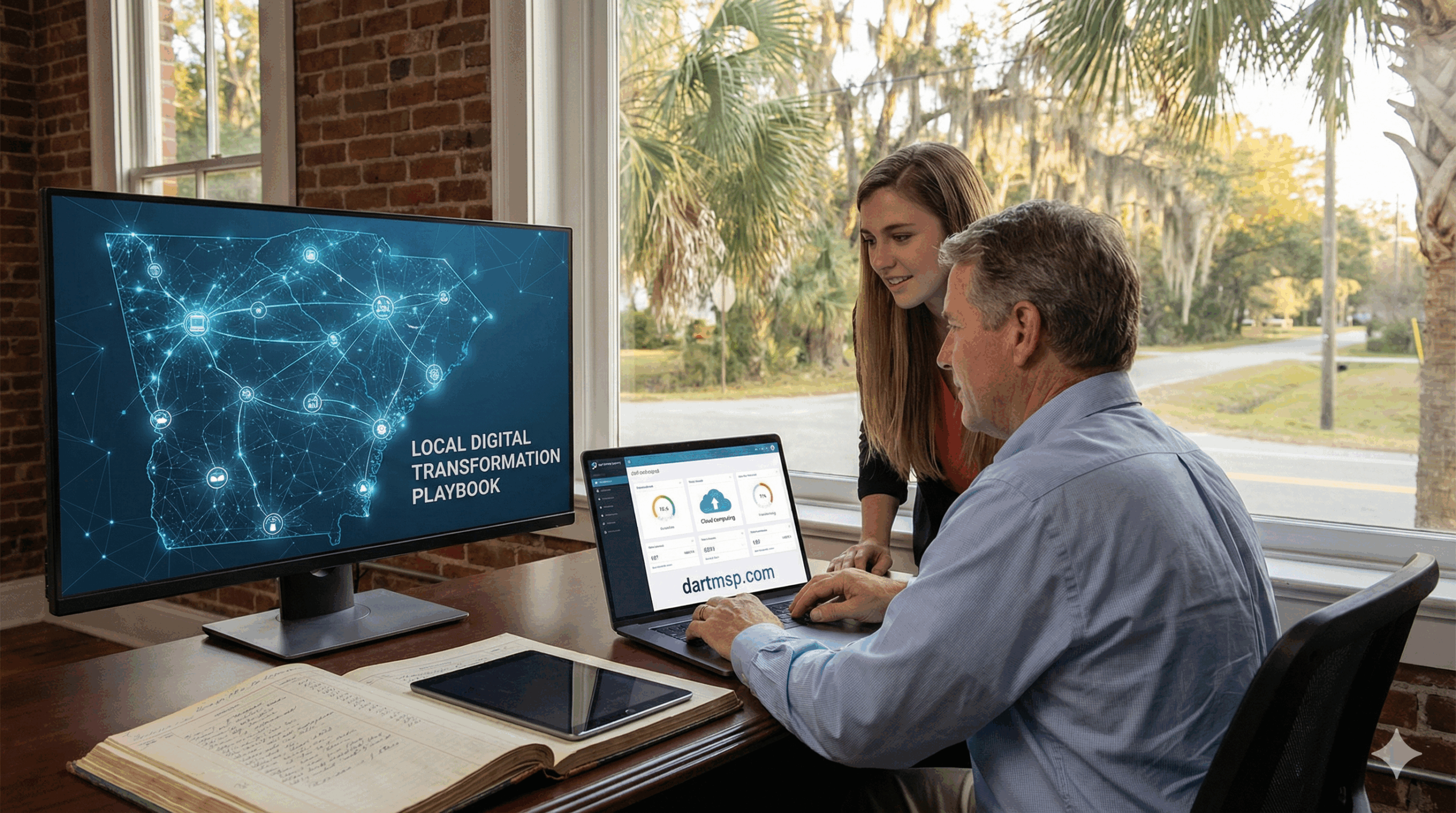
You’ve seen the headlines. “Digital Transformation is Here.” “AI is Changing Everything.” It feels like every day there’s a new technology you’re supposed to be adopting, a new trend you’re falling behind on. And honestly, for a small or mid-sized business owner in Georgia or South Carolina, most of that advice feels like it’s being shouted from a different planet.
A report from Salesforce might tell you about global cloud adoption rates, but it doesn’t know about the spotty internet in a rural Low Country county. A national article talks about the “Great Resignation” driving remote work, but it doesn’t understand the deeply ingrained office culture of many Southern industries.
Here’s the truth: The digital transformation story isn’t one-size-fits-all. It’s a tale of two states—and countless unique businesses within them.
This isn’t another generic list of tech trends. This is your local playbook. We’re going to translate the national hype into an actionable strategy for your business, right here in the Low Country. We’ll look at what’s really happening on the ground with cloud adoption, unpack the very different remote work cultures in Georgia versus South Carolina, and find practical ways to use new tech to solve old problems.
Let’s get started.
Table of Contents
- The Big Picture: National Trends, Local Questions
- Deep Dive: Cloud Adoption in the Low Country – Reality vs. Hype
- Navigating the Remote & Hybrid Work Divide in Georgia vs. South Carolina
- The Georgia Story: Taming the Wild West of Remote Work
- The South Carolina Challenge: Building the Case for Flexibility
- AI & Automation: More Than Just Buzzwords for Southern Efficiency
- Your Local Digital Transformation Roadmap: A Practical Framework
- Frequently Asked Questions
- Conclusion: From Trends to Traction
The Big Picture: National Trends, Local Questions
Before we dive deep, let’s get a lay of the land. Nationally, there are a few massive shifts happening that form the backdrop of our local conversation:
- Cloud Dominance: Businesses are moving away from physical, on-site servers to cloud-based platforms like Microsoft 365 and Google Workspace.
- The Hybrid Workplace: Remote work, in some form, is here to stay, forcing companies to rethink everything from cybersecurity to collaboration.
- AI & Automation: Artificial intelligence is moving from science fiction to practical business tools that can handle repetitive tasks and uncover insights.
- Cybersecurity as a Priority: As businesses become more digital, the risk of cyberattacks has skyrocketed, making robust security non-negotiable.
National data shows that 63% of small business workloads are now running in the cloud. That’s a huge number. But it immediately raises local questions:
- What does that 63% figure actually mean for a manufacturing plant in Upstate South Carolina versus a law firm in Atlanta?
- Are my local competitors part of that 63%, and am I falling behind if I’m not?
- How does this trend apply when my business relies on specialized, on-premise software?
These are the right questions to ask. Because a national average is just a signpost, not a destination.
Deep Dive: Cloud Adoption in the Low Country – Reality vs. Hype
Let’s be direct about something: there are no public, state-level statistics on cloud adoption for small businesses in Georgia or South Carolina. Nobody is tracking this at a local level.
And maybe that’s for the best. It forces us to stop chasing a number and start talking about the why. Why are businesses from Savannah to Greenville making the switch? It usually boils down to a few key motivators that resonate deeply in our region.
- For the Logistics & Distribution Hubs (Savannah, Atlanta, Charleston): Scalability is everything. The cloud allows a growing logistics company to scale its operations up or down without massive capital investment in new servers. It provides the flexibility needed to manage seasonal demand and a distributed workforce.
- For Professional Services (Legal, Accounting, Finance): Security and compliance are paramount. Storing sensitive client data on a secure, encrypted cloud platform with built-in disaster recovery is a massive upgrade from a server closet down the hall. It’s not just a convenience; it’s a critical part of modern risk management.
- For Construction and Trades: Collaboration is key. A construction firm can use cloud-based tools to share updated blueprints and project files in real-time between the office and a job site miles away, reducing errors and saving costly trips.
Moving to the cloud isn’t about hitting a national benchmark. It’s about solving a specific business problem. It’s about finally getting rid of that aging server you worry about every time a thunderstorm rolls through. It’s about enabling your team to work securely from anywhere. When you look at it that way, the decision becomes much clearer. The right managed IT services partner can help you figure out a cloud strategy that fits your actual business needs, not just a national trend.
Navigating the Remote & Hybrid Work Divide in Georgia vs. South Carolina
Nowhere is the difference between our two states more apparent than in the approach to remote and hybrid work. While they’re neighbors, Georgia and South Carolina have developed distinctly different work cultures in the post-2020 landscape. Understanding this is key to building a strategy that actually works for your team.
The Georgia Story: Taming the Wild West of Remote Work
Georgia, particularly in the Atlanta metro area, has seen a much higher adoption rate of remote and flexible work. But here’s the catch: for many businesses, this shift happened out of necessity, not strategy. It was a scramble. And now, many are living with the consequences of an informal, “figure it out as we go” approach.
If you’re a Georgia business leader, these challenges probably sound familiar:
- Informal Policies: You let your team work from home, but there’s no official policy. Who is responsible for providing equipment? What are the expectations for response times? This ambiguity creates confusion and inconsistency.
- Productivity Worries: You trust your team, but you can’t shake the feeling that you don’t have good visibility into what’s getting done. The old way of “management by walking around” is gone, and you haven’t replaced it with a new system.
- Security Gaps: Your employees are accessing company data from their home Wi-Fi networks, on personal devices, and outside your carefully controlled office network. This is a massive security risk waiting to happen.
Your Playbook for Georgia: The goal isn’t to get people back to the office; it’s to bring structure and security to the flexibility you already have.
- Formalize Your Policy: Create a simple, clear Remote Work Policy. It doesn’t have to be a 50-page legal document. Just outline the expectations for communication, availability, and security.
- Focus on Outcomes, Not Hours: Shift your management style to focus on results. Use project management tools to track progress and set clear goals and deadlines.
- Secure the Edge: This is critical. You must ensure every remote employee has a secure connection (like a VPN), multi-factor authentication, and endpoint protection on their devices. Strong cybersecurity and network security isn’t just for the office anymore; it has to extend to every kitchen table and home office.
The South Carolina Challenge: Building the Case for Flexibility
In contrast, many industries in South Carolina have maintained a more traditional, in-office culture. The adoption of remote work has been slower, and there’s often a healthy dose of skepticism from leadership. The challenge here isn’t managing a remote workforce—it’s getting the buy-in to create one in the first place.
If you’re a business leader in South Carolina, your battle is often fought before a single employee works from home.
- Cultural Resistance: The prevailing belief might be, “We’ve always done it this way, and it works.” Or the fear that “if I can’t see them, they aren’t working.”
- Talent Competition: You’re competing for top talent not just with other local companies, but with businesses in Charlotte and Atlanta that offer the flexibility candidates now expect.
- Lack of Infrastructure: Your current IT setup may be entirely centered around your physical office, with no easy way to provide secure remote access to files and applications.
Your Playbook for South Carolina: The goal is to make a compelling business case for flexibility and start small with a pilot program.
- Frame it as a Competitive Advantage: Don’t talk about remote work as an employee perk. Talk about it as a strategy to attract and retain the best talent in a competitive market.
- Start with a Pilot Program: You don’t have to go all-in at once. Identify a small team or department and run a hybrid work pilot for one or two days a week for a quarter. Measure the results. Did productivity drop? Did employee satisfaction improve? Use data to overcome fear.
- Build the Foundation First: Before you start a pilot, work with an IT partner to build the necessary infrastructure. Set up secure remote access and ensure you have the tools for effective remote collaboration. Prove that it can be done securely and efficiently.
AI & Automation: More Than Just Buzzwords for Southern Efficiency
Let’s be honest, the term “AI” can be intimidating. It brings up images of complex algorithms and robots. But for most SMBs, the reality of AI and automation is much more practical and down-to-earth. It’s about using smart tools to do more with less.
Think of it as giving your best employee a superpower.
- For Manufacturing in Upstate SC: You’re not buying a robot to replace your line workers. You’re using an AI-powered tool to analyze your supply chain and predict inventory needs more accurately, reducing waste and preventing stockouts.
- For Accounting Firms in Columbia: You’re not replacing your accountants. You’re using automation software to handle the tedious, time-consuming task of data entry from receipts and invoices, freeing up your team to focus on high-value client advisory work.
- For Marketing Teams in Charleston: You’re using AI tools to analyze which email subject lines get the best open rates or to draft initial social media posts, saving hours of manual work.
The key is to start small. Don’t try to “implement an AI strategy.” Instead, ask a simple question: “What is the most repetitive, annoying task my team has to do every week?” Chances are, there’s a simple automation tool that can help. Getting expert IT consulting can help you identify these low-hanging-fruit opportunities that provide a quick and tangible return on investment.
Your Local Digital Transformation Roadmap: A Practical Framework
Knowing the trends is one thing. Doing something about them is another. This process can feel overwhelming, but it doesn’t have to be. You can start building your roadmap by asking a few simple questions.
Grab a notepad and walk through this self-assessment:
- Infrastructure: Where does our company data live? Is it on a server in the office, in the cloud, or a mix of both? How old is that server?
- Accessibility: Can my team securely access everything they need to do their jobs if they can’t get to the office? What would happen if our office was inaccessible for a week?
- Security: How confident am I that our client data and financial information are protected from a cyberattack? Do we have multi-factor authentication on our accounts? When was the last time our team had security training?
- Collaboration: What tools do we use to communicate and work on projects together? Are they effective, or do they create more confusion?
- Efficiency: What manual, repetitive tasks are eating up my team’s time? Where are our biggest bottlenecks?
Your answers will start to reveal your priorities. Maybe your biggest issue is an aging server. Or perhaps your immediate need is to secure your informal remote work setup.
Once you have a sense of your priorities, you might start talking to potential IT partners. Here are the questions you should be asking them to separate the experts from the salespeople:
- Can you share an example of how you’ve helped a business in my industry solve a similar problem?
- How do you approach cybersecurity for a business with a hybrid workforce?
- What is your process for managing a project like a cloud migration? What does your team handle, and what do you need from my team?
- How do you measure the success of your work? What metrics will we look at to see if this investment is paying off?
- What does your support look like after the initial project is done?
Listen carefully to their answers. You’re not just buying a piece of technology; you’re looking for a partner who understands your business and can guide you through the process.
Frequently Asked Questions
Is digital transformation too expensive for my small business?
It doesn’t have to be. The key is to focus on scalable, subscription-based solutions (like Microsoft 365) instead of large, upfront capital expenses. A good IT partner will help you create a phased roadmap that aligns with your budget, tackling the highest-priority items first. The cost of inaction—like a data breach or extended downtime—is often far greater.
This all sounds complicated. How do I know where to start?
You’ve already started by reading this. The next step is the simple self-assessment in the section above. Answering those five questions will give you a much clearer picture of your immediate needs. Don’t try to boil the ocean; just identify the one or two things that are causing the most pain or creating the most risk for your business right now.
My current setup is working fine. Isn’t this just fixing something that isn’t broken?
“Good enough” is the enemy of “great.” Your current setup might seem fine, but it could be holding you back in ways you don’t even realize. It might be creating hidden security vulnerabilities, making it harder to attract top talent, or causing small, daily inefficiencies that add up to thousands of dollars in lost productivity over a year. Digital transformation isn’t just about avoiding disaster; it’s about unlocking opportunity.
Conclusion: From Trends to Traction
Digital transformation isn’t a destination you arrive at. It’s an ongoing process of aligning your technology with your business goals. For small and mid-sized businesses in Georgia and South Carolina, it’s not about chasing every new Silicon Valley buzzword.
It’s about making smart, practical decisions that make your business more resilient, more efficient, and more competitive right here at home.
It’s about understanding that the path forward for a business in Atlanta is different from one in Greenville. It’s about building a secure foundation for flexible work, leveraging the cloud to protect your critical data, and finding simple ways to automate tasks so your team can focus on what they do best.
You don’t have to navigate this landscape alone. Having a guide who understands both the technology and the local business environment is the single most important factor for success.
If you’re ready to move beyond the trends and build a technology strategy that works for your specific situation, let’s talk. Schedule a no-obligation strategy session with our team, and let’s discuss how these trends apply to you.