
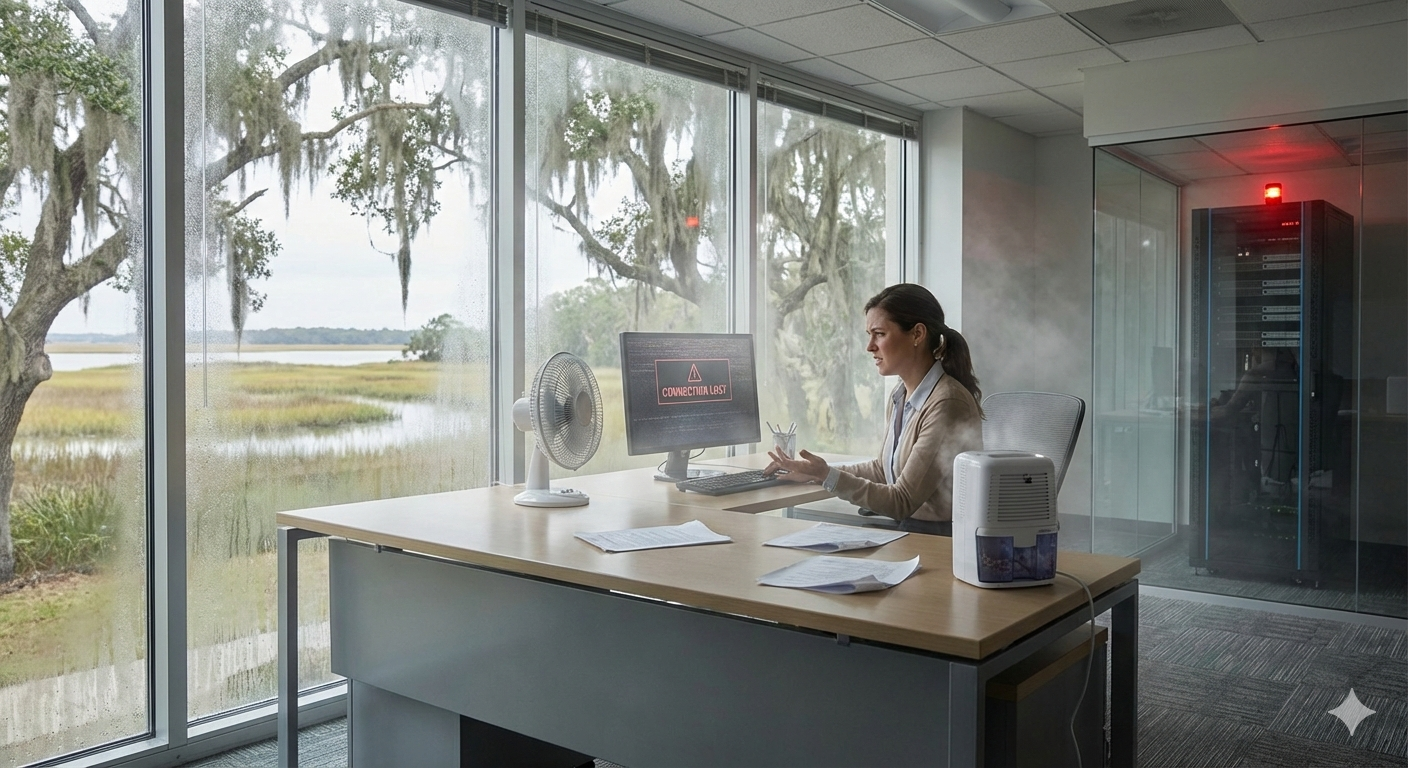
Let’s be honest. There’s a reason we choose to live and work here in the Low Country. It’s the smell of the salt marsh at high tide, the ancient live oaks dripping with Spanish moss, the feeling of a community that’s weathered a few storms together.
But that same environment we love is quietly, consistently, trying to kill your technology.
If you’re a business owner in Savannah, Bluffton, Beaufort, or anywhere along this beautiful, unforgiving coast, you’ve probably been given the standard IT disaster-prep speech. “Back up your data. Get a generator.” It’s well-intentioned, but it’s dangerously incomplete. It completely misses the real, day-in-day-out threats that define our region.
This isn’t about just surviving the next hurricane. This is about surviving the Tuesday afternoon humidity, the corrosive salt fog that rolls in overnight, and the power grid that flickers with every summer thunderstorm. These are the silent killers of coastal IT infrastructure. The national IT playbook simply wasn’t written for us.
This guide is. We’re going to pull back the curtain on the specific IT challenges for coastal businesses and give you the technical, actionable framework you need to build a truly resilient operation. We’ll go beyond the basics and talk about the specific hardware standards, environmental controls, and strategic decisions that separate the businesses that thrive from those that get washed away—figuratively and literally.
Table of Contents
- The Hidden Threat: Quantifying Your True Coastal Risk
- Challenge #1: The Slow, Silent Killer of Salt & Humidity
- The Solution Standard: NEMA 4X Enclosures Aren’t Optional
- Beyond the Box: Hardware That Lasts
- Challenge #2: When the Air Itself Becomes the Enemy
- Getting Your Server Room Climate Right
- Challenge #3: Disaster-Proofing for Hurricanes & Floods
- Rethinking Your Data Backup Strategy for the Low Country
- Uninterruptible Power is Non-Negotiable
- Keeping Your Team Connected When It Matters Most
- The Big Decision: DIY Coastal IT vs. Partnering with a Local Expert
- The Low Country MSP Vetting Checklist
- Beyond Survival: Leveraging Resilience for Growth
- Key Takeaways: Your Coastal IT Resilience Plan
- Frequently Asked Questions
The Hidden Threat: Quantifying Your True Coastal Risk
It’s easy to become numb to the big numbers we hear on the news during hurricane season. But to make smart decisions, you need to understand the financial reality.
Since 1980, hurricanes have caused over $1.5 trillion in damage in the United States, according to NOAA. The average cost per storm is a staggering $23 billion. And the Congressional Budget Office estimates that commercial properties suffer between $9 and $12 billion in losses every year from these events.
But here’s the statistic that should really get your attention. Research cited by ENERGY STAR found that data centers in hot, humid climates experience component failure rates 107% to 260% higher than those in drier, more temperate locations.
Think about that. Before a single storm cloud appears on the horizon, the very air in your office is doubling or tripling the likelihood that your servers, switches, and workstations will fail. This isn’t a hypothetical storm scenario; this is a clear and present operational risk, happening every single day. The cost of ignoring it isn’t just the price of a new server; it’s the cost of lost productivity, missed deadlines, and reputational damage when your systems go down unexpectedly.
Challenge #1: The Slow, Silent Killer of Salt & Humidity
You can’t see it, but it’s everywhere. A fine, aerosolized salt carried on the humid coastal air. It settles on every surface, including the delicate motherboards, processors, and power supplies that run your business. We call it “salt creep,” and when it combines with our year-round humidity, it creates a corrosive electrochemical reaction that eats away at metal contacts and circuits.
This is the number one reason why standard, off-the-shelf IT hardware has such a short, brutal life here. The fans in your servers and network gear don’t just pull in air for cooling; they actively pull in this corrosive salt mist, coating every critical component.
The Solution Standard: NEMA 4X Enclosures Aren’t Optional
So how do you fight an invisible enemy? You create a sealed, protected environment. And in the world of industrial and electrical hardware, there’s a gold standard for this: the NEMA rating.
NEMA, the National Electrical Manufacturers Association, sets standards for electrical enclosures. You might see a “NEMA 3R” rating on an outdoor utility box, which means it’s protected from rain and sleet. That’s not good enough for us.
For any coastal business with on-premise IT infrastructure, the mandatory minimum standard is NEMA 4X. Here’s what that “4X” gets you:
- Watertight: It can be hosed down without a single drop getting inside. This means it’s protected against heavy rain, storm surge spray, and even a broken pipe in your office.
- Corrosion Resistance: This is the “X” and it’s the most important part. NEMA 4X enclosures are typically made of stainless steel or corrosion-resistant polycarbonate. They are specifically designed to withstand saltwater spray and harsh chemical environments.
Putting your critical network switches, firewalls, and servers inside a NEMA 4X-rated cabinet is the single most effective step you can take to combat salt-air degradation. It’s not an upgrade; it’s a baseline requirement for doing business on the coast.
Beyond the Box: Hardware That Lasts
The enclosure is your first line of defense, but smart hardware selection matters, too. When possible, look for:
- Conformal Coated Circuit Boards: A thin, protective chemical layer applied to electronics to insulate them from moisture and contaminants.
- Sealed Hard Drives: Solid-state drives (SSDs) are naturally more resilient as they have no moving parts, but even traditional spinning drives can be found in sealed, ruggedized versions.
- Vapor Corrosion Inhibitors (VCIs): Small packets or emitters that can be placed inside an enclosure to release a vapor that bonds to metal surfaces and prevents corrosion.
Challenge #2: When the Air Itself Becomes the Enemy
You know that feeling when you walk outside in July and the air is so thick you can practically drink it? Your servers feel it, too. And they hate it.
The industry-accepted standard for relative humidity (RH) in a server room is between 40% and 60%. When the humidity climbs above 60%—a daily reality for much of the year in the Low Country—two dangerous things happen:
- Condensation: Just like a glass of iced tea on a summer day, cool metal components inside your servers can cause moisture to condense directly onto the circuit boards. A single drop in the wrong place can cause a catastrophic short circuit.
- Accelerated Corrosion: As we discussed, high humidity is the catalyst that makes salt air so destructive. The higher the RH, the faster your equipment will corrode and fail.
Conversely, if the air is too dry (below 40% RH), the risk of electrostatic discharge (ESD) increases dramatically. A static shock that’s barely perceptible to you can be enough to fry a sensitive microchip.
Getting Your Server Room Climate Right
Your standard office HVAC system is not designed to solve this problem. It’s built for human comfort, not for maintaining the precise 40-60% RH range your technology needs to survive.
To truly protect your investment, you need a dedicated climate control solution for your server room or IT closet. This could range from a commercial-grade dehumidifier for a small setup to a full-fledged Computer Room Air Conditioning (CRAC) unit that precisely manages both temperature and humidity.
Monitoring this environment is just as important. Simple, inexpensive sensors can alert you the moment conditions fall out of the safe zone, giving you time to react before a minor issue becomes a major failure.
Challenge #3: Disaster-Proofing for Hurricanes & Floods
Now we get to the main event. With our defenses against the daily threats of salt and humidity in place, we can build a strategy that will withstand a major storm. True disaster recovery and business continuity in the Low Country isn’t just a plan in a binder; it’s a tested, resilient system.
Rethinking Your Data Backup Strategy for the Low Country
You’ve probably heard of the 3-2-1 backup rule: Keep 3 copies of your data on 2 different types of media, with 1 copy off-site.
It’s a great start, but for coastal businesses, it needs an amendment. The Low Country 3-2-1 Rule is the same, but with a critical clarification: “off-site” can’t mean in a building across the street. A hurricane or major flood can easily take out an entire town or county.
Your one off-site copy must be geographically distant. This means leveraging a robust cloud backup solution that replicates your data to data centers in different regions of the country—places like Dallas, Chicago, or Phoenix that are safe from the coastal threats we face. This ensures that even if your entire physical location is inaccessible, your data is safe and recoverable.
Uninterruptible Power is Non-Negotiable
A generator is crucial, but it’s only half of the power equation. What happens in the seconds or minutes it takes for the generator to kick on? Or during the constant brownouts and power surges that precede and follow a major storm?
That’s where an Uninterruptible Power Supply (UPS) is essential. A UPS is a large battery that your critical systems are plugged into. It provides instantaneous, clean power, bridging the gap until the generator is running and protecting sensitive electronics from the “dirty” power that can destroy them. Sizing your UPS and generator correctly is a technical task that requires a clear understanding of your power load and desired runtime.
Keeping Your Team Connected When It Matters Most
When the power is out and cell towers are overloaded, how do you communicate with your employees, customers, and vendors? Old-fashioned copper phone lines are often one of the first things to fail in a storm.
This is why modern communication tools are a cornerstone of any coastal business continuity plan.
- Voice over IP (VoIP): A cloud-based phone system isn’t dependent on local phone lines. As long as you have an internet connection (even a satellite or cellular one), your phones work. You can take and make calls from your laptop or a mobile app anywhere in the world, presenting your main business number.
- Dedicated Internet Access (DIA): While more of an investment than standard business cable, a DIA fiber connection provides a much more reliable and robust link to the outside world, often with service level agreements (SLAs) that guarantee uptime.
Investing in a resilient unified communications as a service (UCaaS) platform means your business’s command and control center can operate from anywhere.
The Big Decision: DIY Coastal IT vs. Partnering with a Local Expert
Reading all this, you might be thinking this sounds complex and expensive. And honestly, it can be.
You could try to piece together this coastal-grade strategy on your own. You’d need to research and source NEMA 4X enclosures, design and install a climate control system, manage and test cloud replication, and maintain a fleet of UPS batteries and a generator. It requires a specific, and frankly, rare, set of expertise.
The alternative is to partner with a team that lives and breathes this stuff. A Managed Service Provider (MSP) that understands the unique challenges of the Low Country because they’re based here, too.
The Low Country MSP Vetting Checklist
Not all IT providers are created equal. When evaluating a potential partner, ask them these specific questions:
- What is your standard for on-premise hardware enclosures in our area? If they don’t immediately say “NEMA 4X,” they don’t get it.
- How do you monitor for environmental threats like high humidity? They should have a clear answer involving sensors and automated alerts.
- Where will our off-site data be replicated? Ask for the specific geographic locations of the data centers.
- Can you show us the results from your last disaster recovery test? A good partner doesn’t just have a plan; they test it regularly.
- What is your hurricane preparedness plan for your own staff and operations? If their office goes down, who is supporting you?
Finding the right partner for managed IT services isn’t about finding the cheapest option; it’s about finding the one who can give you the confidence to focus on your business, knowing your technology is secure, no matter what the weather brings.
Beyond Survival: Leveraging Resilience for Growth
Here’s a final thought that most businesses miss: a robust, well-documented IT resilience plan is more than just an insurance policy. It can be a competitive advantage.
For our local governments and municipalities, a strong IT continuity plan can be a key component in securing federal funding. FEMA grants, like the Building Resilient Infrastructure and Communities (BRIC) program, heavily favor applicants who can demonstrate proactive investments in resilient infrastructure.
For businesses in regulated industries like healthcare (HIPAA) or finance (PCI-DSS), proving that you can protect sensitive data even when your physical environment fails is not optional—it’s a compliance mandate. Being able to demonstrate this level of preparedness to auditors, insurers, and even high-value clients builds an immense amount of trust.
Key Takeaways: Your Coastal IT Resilience Plan
If you skimmed to the end, here’s what you need to know:
- Your Biggest Threat is Daily: Forget hurricanes for a second. The combination of salt air and high humidity is actively degrading your IT equipment right now, causing failure rates to be 100-200% higher than average.
- Demand the Standard: NEMA 4X: For any on-site network gear or servers, corrosion-resistant NEMA 4X enclosures are the only acceptable choice. Don’t compromise.
- Control Your Climate: Your server room must be kept between 40-60% relative humidity. Your office AC isn’t up to the task. Invest in dedicated dehumidification and monitoring.
- Adopt the Low Country 3-2-1 Rule: Your one “off-site” backup must be geographically diverse, ideally in a cloud data center far from the Atlantic coast.
- Vet Your IT Partner on Local Knowledge: Ask potential IT providers specific questions about NEMA ratings, humidity monitoring, and their own storm prep plans. True expertise is in the details.
Frequently Asked Questions
Isn’t a NEMA 4X enclosure overkill for my small business?
Think of it like insurance. The initial cost is higher than a standard rack, but it’s a fraction of the cost of replacing all your equipment after a failure, not to mention the immense cost of downtime. A single corrosion-related outage can easily cost more than the enclosure designed to prevent it.
My server is in an interior room. Am I safe from salt air?
Unfortunately, no. Your HVAC system is constantly pulling in outside air to circulate. That air is filled with the same aerosolized salt that’s outside. Over time, it will find its way into your equipment unless that equipment is in a sealed, protected enclosure.
How much does a proper coastal IT setup cost?
The cost varies widely based on the size and complexity of your business. The right approach is to start with a thorough risk assessment. An expert can help you identify your most critical systems and create a prioritized plan that balances budget with resilience. A strategic IT consulting engagement can provide a clear roadmap and predictable costs.
Can’t I just use cloud services and avoid all of this?
Using the cloud is a fantastic way to reduce your on-site hardware footprint, but it doesn’t eliminate it entirely. You still need reliable power, networking equipment (switches, firewalls), and a resilient internet connection to access your cloud services. A hybrid approach—moving what you can to the cloud while protecting your essential on-site link—is the most effective strategy.
Building a business in the Low Country means embracing the environment, not ignoring it. Your technology strategy should be no different. For over 25 years, Infinity, Inc. has been helping businesses across Savannah and the Low Country build IT systems that are as resilient as the communities we serve.
If you’re ready to move beyond the standard advice and create a technology plan that can truly withstand our unique coastal challenges, let’s talk.